Qué necesitaba resolver el proyecto
Los aerogeneradores suelen ubicarse en colinas, zonas costeras o plataformas alejadas. Las visitas técnicas son costosas y la operación requiere consultar estados y alarmas desde un centro centralizado.

 Energía y servicios públicos · caso documentado
Un gateway LTE compacto comunica el controlador de un aerogenerador con el centro de operación en instalaciones remotas.

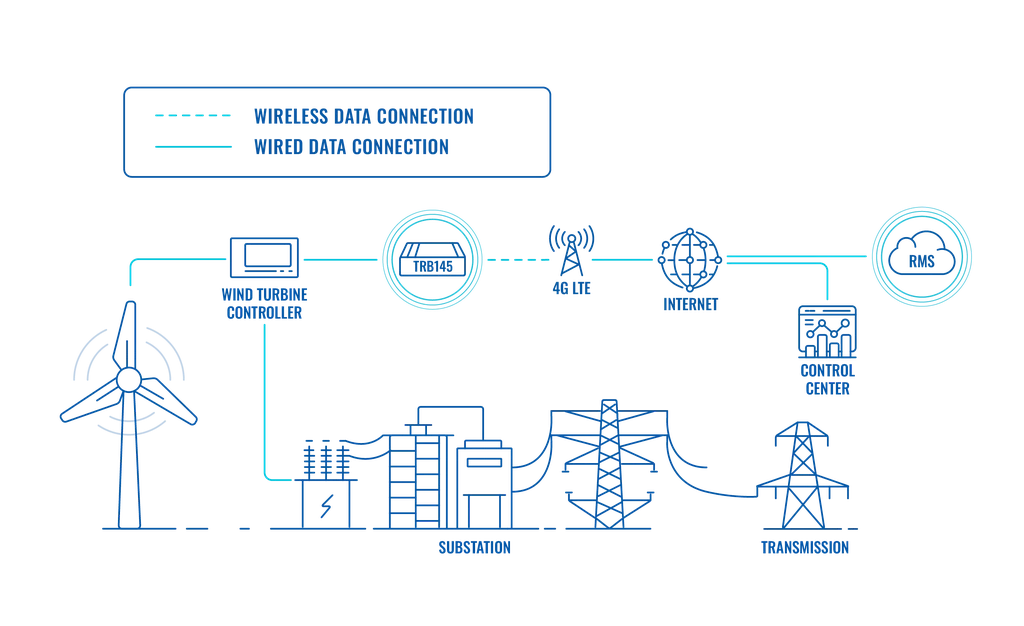
El diagrama original muestra los equipos y enlaces que componen esta aplicación. Amplíalo para revisar sus conexiones.
 Ampliar diagrama
Controlador del aerogenerador → enlace serial/industrial → TRB145 → LTE → centro de monitoreo y plataforma de operación.
Los aerogeneradores suelen ubicarse en colinas, zonas costeras o plataformas alejadas. Las visitas técnicas son costosas y la operación requiere consultar estados y alarmas desde un centro centralizado.
El gateway celular TRB145 se integra con la unidad de control del aerogenerador a través de una interfaz serial y reenvía información a la plataforma remota. La conexión celular brinda una alternativa donde el cableado de telecomunicaciones no es práctico; los protocolos y las funciones de control deben ajustarse al controlador instalado.
La implementación debe seguir las interfaces y protocolos descritos en la ficha del producto y en la documentación de los equipos conectados.
El controlador local mide estados, variables y eventos de la turbina.
TRB145 recoge los datos por su interfaz serial compatible con el proyecto.
El gateway transmite la información al centro por una conexión LTE disponible.
El personal autorizado consulta el estado y gestiona tareas remotas según la política OT.
La topología es una referencia. La selección final depende de las condiciones del sitio y los equipos reales.
Datos de la turbina accesibles desde un centro remoto.
Menos inspecciones presenciales para consultas de estado.
Conectividad replicable para sitios fuera de la red fija.
✔ Wind farms are often located in remote, harsh environments where reliable industrial-grade connectivity is critical for continuous operations.
✔ Without a stable connection to turbine controllers, operators cannot perform wind turbine remote monitoring, predictive maintenance, or real-time parameter adjustments.
✔ Teltonika TRB145 4G IoT gateway provides a secure, low-power connection between wind turbine PLCs and the central control centre.
✔ Paired with Teltonika RMS, operators can remotely manage, monitor, and receive alerts across an entire wind farm fleet from a single platform.
Wind energy is one of the fastest-growing renewable energy sources globally, and for good reason – wind farms can generate clean electricity at scale with minimal environmental impact. According to the World Wind Energy Association (WWEA), global installed wind power capacity now meets well over 10% of the world's electricity demand, with total capacity surpassing 1,170 Gigawatts in 2024.
However, deploying and maintaining wind turbines comes with a unique operational challenge. These installations are typically located in remote, hard-to-reach areas such as open hillsides, coastal zones, and offshore platforms, precisely because those locations offer the strongest and most consistent wind conditions year-round. This means that sending technicians on-site for every maintenance check or configuration change is not only costly and time-consuming, but often impractical.
To keep wind turbines running efficiently and safely, operators need reliable, secure, and always-on wind turbine connectivity solution – enabling real-time monitoring, energy generation reporting, and predictive maintenance from a centralised control centre.
Teltonika TRB145 is a compact 4G IoT gateway designed specifically for demanding environments like wind turbine installations. It connects directly to the wind turbine controller – typically a PLC – via its RS485 Serial interface, acting as a Modbus RTU gateway that bridges the turbine's control system with the operator's remote management infrastructure.
This makes it possible to monitor wind turbines, push configuration updates, and respond to faults remotely – no physical presence on-site needed. The device also consumes just 2W of power during data transfer, making it well-suited for energy-conscious deployments where every watt counts.
Security is built in from the ground up: the TRB145 runs RutOS, Teltonika's proprietary operating system, which includes enterprise-grade features such as OpenVPN, IPsec tunnelling, and a configurable firewall – ensuring that all data transmission between the turbine and the control centre is encrypted and protected.
Its rugged housing supports an operating temperature range of -40°C to 75°C, meaning it can withstand the extreme weather conditions typical of wind farm sites without compromising performance.
And because wind farms often consist of dozens or even hundreds of turbines, the TRB145 integrates seamlessly with Teltonika RMS – a cloud-based Remote Management System that allows operators to configure, monitor, and receive SMS or email alerts from an unlimited number of devices, all from a single dashboard.
From secure data transmission to rugged field deployment and scalable fleet management, the TRB145 brings together everything wind farm operators need in a single compact device – making it one of the most practical and reliable industrial IoT connectivity solutions available for wind energy infrastructure today.
Ready to get started? Order the TRB145 or reach out to our team – we'll help you find the right solution.
Esta referencia internacional puede orientar una evaluación para energía y servicios públicos en Colombia. La publicación original describe el proyecto en su contexto; cualquier adaptación local debe validar cobertura, interfaces, seguridad y condiciones del sitio.
Valida el modelo exacto, las interfaces y las condiciones de cobertura antes de llevar el diseño a campo.
La referencia documentada incluye TRB145. La selección final debe considerar modelo, interfaces, cobertura, firmware y disponibilidad local.
Controlador del aerogenerador → enlace serial/industrial → TRB145 → LTE → centro de monitoreo y plataforma de operación.
Verificar interfaz serial, protocolo, velocidad y aislamiento del controlador. Medir cobertura celular y disponibilidad de antena en altura. Revisar protección contra sobretensión, tierra y condiciones ambientales.
Compártenos el modelo de tus equipos, las interfaces, la ubicación y el tipo de conexión disponible. Un asesor de OptimusTech puede ayudarte a evaluar la referencia Teltonika adecuada.
Solicitar asesoría