


Highlights
✔ Electricity utility sectors, renowned for handling vast data volumes, require top-tier connectivity support for efficient monitoring, control, and intervention of thousands of endpoints, often located in remote locations to provide continuous electricity supply.
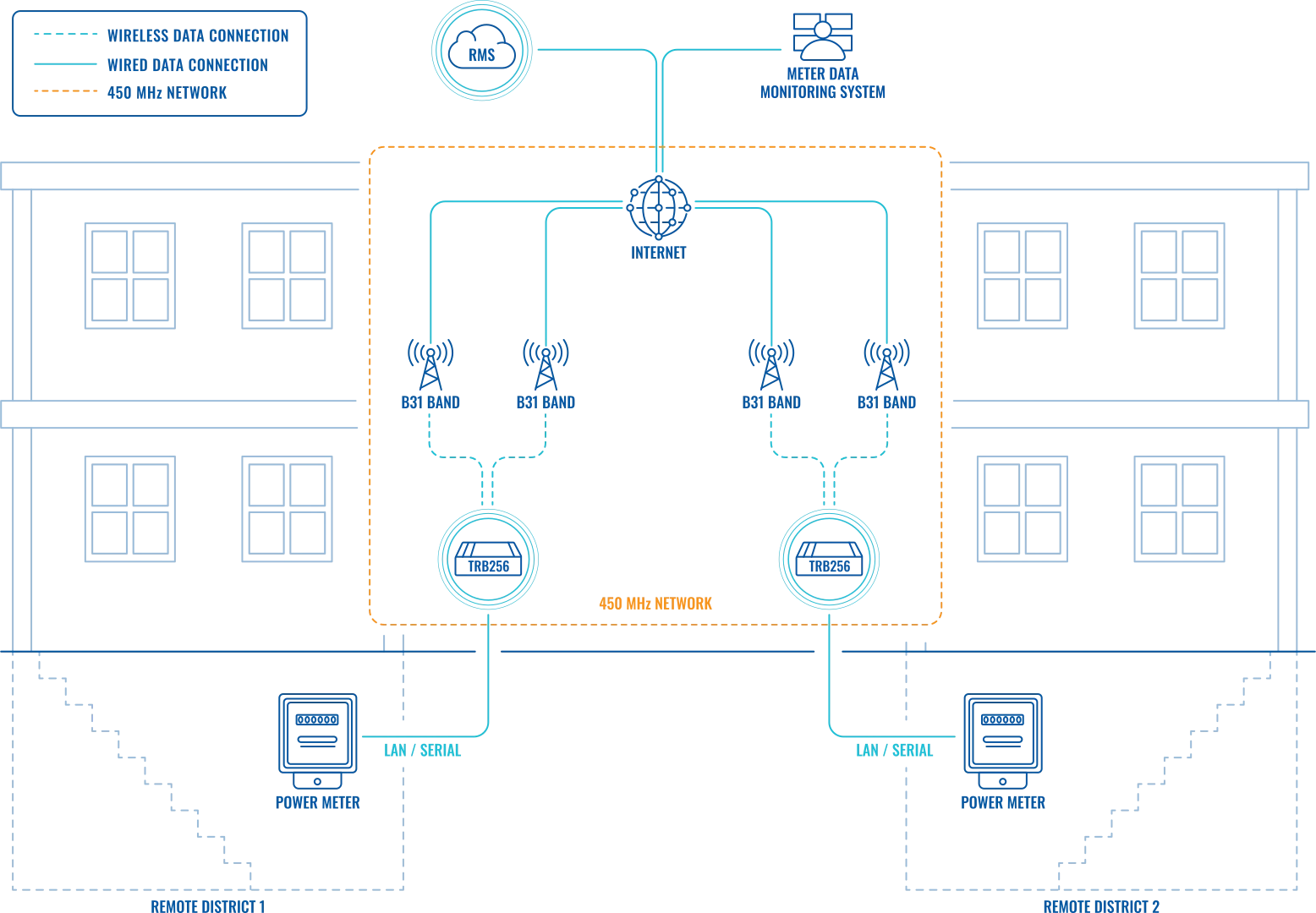
✔ The Teltonika Networks TRB256 IoT gateway, featuring 450 MHz frequency band support, serves as the uniting piece of electricity generators in residential building basements and remote head-end systems, providing robust connectivity support and instantaneous data transmission between the two endpoints.
✔ This IoT gateway has multiple interfaces, like RS232 and RS485, and supports a wide variety of industrial M2M communication protocols, enabling diverse energy and utility sector equipment to be easily connected with one another.
The challenge – in search for private networks
With today’s smart grid development, the electricity utility sector can’t run away from the implementation of solution advancements. Partly because they have bad luck with mobility but also because they’re involved in the progress of Industry 4.0 and IoT.
But with these technological innovations come vast amounts of data. While they’re invaluable for conducting predictive maintenance and data analytics for continuous electricity supply, they’re also demanding for elevated standards in connectivity to ensure its integrity and security.
Utility companies deal with data sent continuously and in real-time from thousands of endpoint systems, often located in remote and inaccessible areas. So, it certainly doesn’t help that these systems tend to be based within buildings or in their basements, which can disrupt the connectivity signal.
Another issue revolving around utility data comes from its transmission. Public networks that work on 900 MHz or higher frequency bands can sometimes be insufficient and less reliable due to their congestion and worse wall penetration. Additionally, public networks, as opposed to private networks, are more vulnerable to security issues that can lead to data corruption, downtime, or unauthorised access.
We certainly can’t forget data reading, which is highly dependent on the protocol support of machinery and networking devices used within the system. Non-compliant supported protocols can require additional interface devices or software to bridge the gap. This often results in redundant systems and a more complex network infrastructure, unnecessarily complicating the overall process.
The solution – the search ends with the TRB256
In unity there is strength, and the Teltonika Networks TRB256 IoT gateway embodies this principle as a critical connective component. Its secret weapon? Support of the 450 MHz frequency band, also known as B31.
Positioned in residential building basements, this IoT gateway connects to energy meters through RS232, RS485 or LAN interfaces and serves a dual purpose: providing highly reliable and robust network connectivity and acting as an M2M communication intermediate.
Since this IoT gateway supports the private network’s 450 MHz band, it can easily realise mission-critical tasks such as data transmission and connectivity support. How so? The 450 MHz frequency band is ideal for NB-IoT and LTE-M-reliant solutions, which the TRB256 accommodates. Suited for low-power wide area networks, this cellular communication technology, compliant with the TRB256, simplifies overcoming challenging environments.
This frequency band is known for its excellent wall penetration and radio frequency spread, allowing the industrial gateway to effortlessly relay data packets for head-end systems for remote monitoring of data and remote management of IoT solutions.
Additionally, the TRB256 industrial gateway performs flawlessly with power consumption rates ranging from over 1.2 W to below 3.5 W at max. Such low power consumption of the TRB256 makes it particularly great for applications where the cost-to-effectiveness ratio is considered paramount.
The spectacular nature of this solution would be diminished if extra data converters were needed – but it doesn’t!
The TRB256 IoT gateway supports a myriad of industrial M2M communication protocols, like Modbus, DNP3, DLMS, OPC UA, and BACnet. This versatility allows IoT solutions to tailor their network infrastructure according to supported machinery protocols, ensuring real-time, convenient data receipt.
This industrial-grade IoT gateway is one of a kind. Multiple supported interfaces, industrial protocols, and private networks position the TRB256 as a top choice for the energy and utility sectors.