

Highlights
✔ Smart grids offer efficient monitoring and management of energy grid operations. To achieve this, energy grid modernisation requires a reliable networking device capable of keeping the network simple by supporting different interfaces and protocols used by legacy equipment.
✔ The perfect device for this job is the TRB142 cellular gateway by Teltonika Networks. This IoT gateway comes with the widely-used RS232 serial interface and supports a host of critical industrial protocols, including Modbus RTU, MQTT, DHCP, SNMP, and DNP3.
✔ In addition, this compact and affordable IoT gateway supports 4G, 3G, and 2G technologies, is compatible with RMS for enhanced remote access and management capabilities, and ensures easy deployment, installation, and scalability.
The challenge – entropy in smart grids
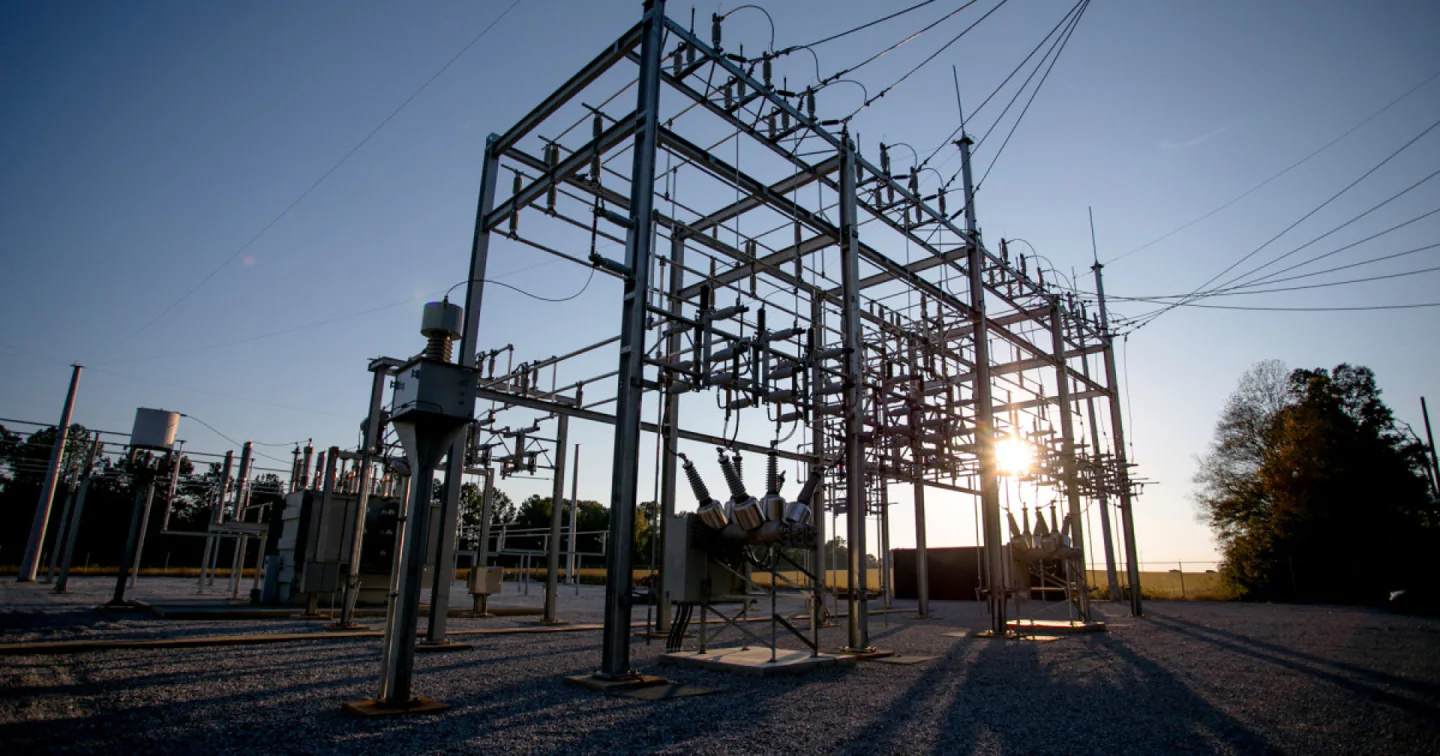
At its core, energy infrastructure revolves around production and transmission. Energy is generated and then transmitted to energy grids via high, medium, and low-voltage stations and substations. From there, energy grids reach homes and businesses around the world, allowing you to read these very words.
This is a complex, multistep process, so ensuring the health of this infrastructure and the efficiency of each step is of vital importance. Doing so requires continuous monitoring and control of the system, which in turn requires all its moving parts to be connected to an IoT network.
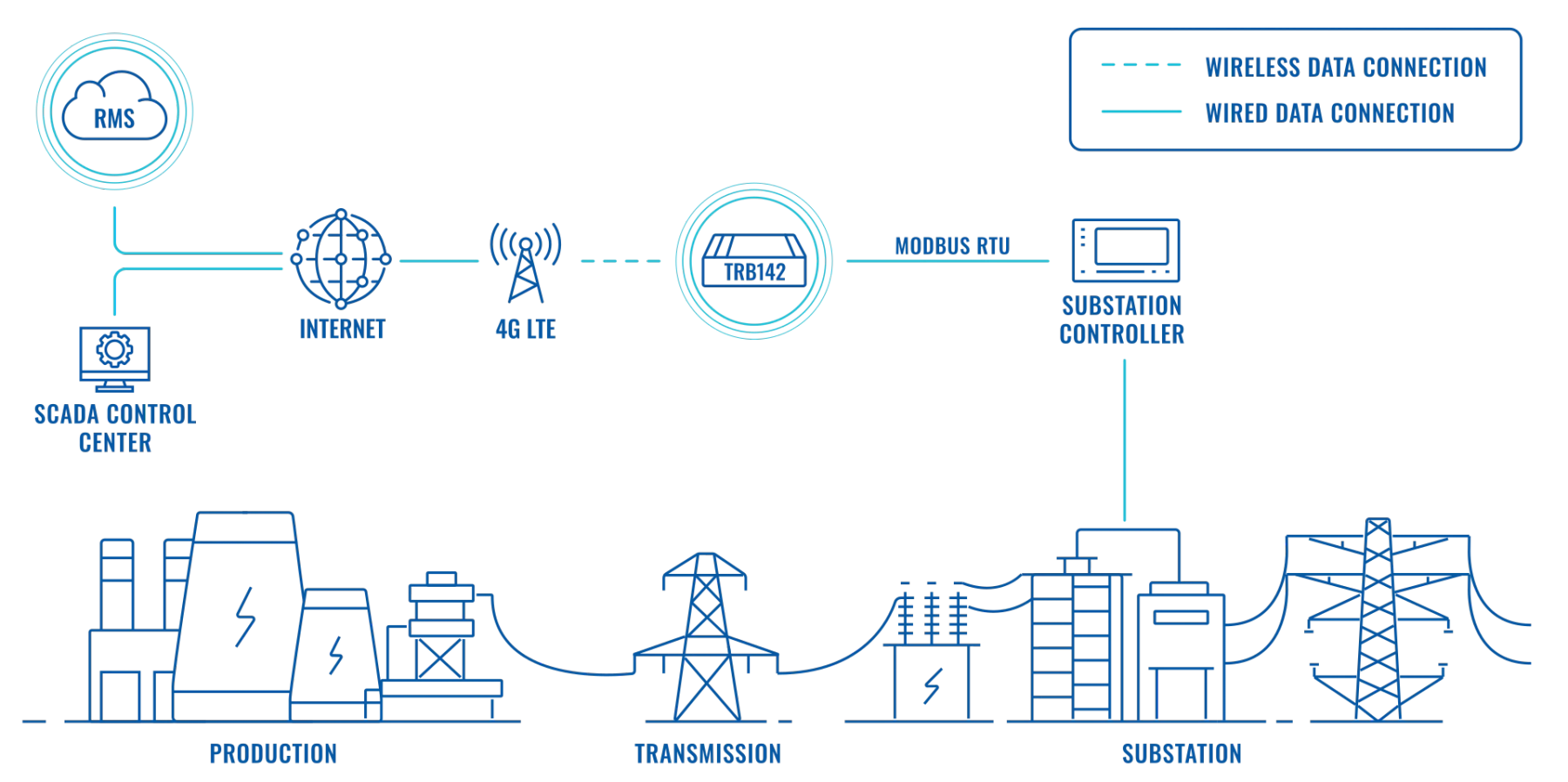
In practice, this isn’t always the case. Station networks are managed by engineers and advanced supervisory control and data acquisition (SCADA) systems, while the substation networks are managed by the substation controller. In other words – division instead of cohesion.
To enable smart grid technology, which is to say – a cohesive energy grid constituting a single IoT network, each substation network must be connected to the greater, station network. This means the grid network grows in volume, its scale of automation increases – and a smart grid is born.
But alas, the 2nd law of thermodynamics states that in an isolated system, entropy can only increase. In the realm of IoT-powered smart grids, this entropy manifests in the inevitable downtime of the system. The larger the network, the more this entropic downtime negatively impacts its overall performance and reliability.
Downtime cannot be entirely avoided, but it can definitely be minimized. The problem is that substations employ different legacy equipment. An optimised network should simplify communication to these legacy equipment and maintain as stable and seamless a connection as possible.
The solution – smart grid IoT gateway
Many keyholes require many keys, but a single keyring is all it takes to stay efficient. In this case, the keyring is the TRB142 cellular gateway by Teltonika Networks. Taking the example of an electric power grid, this industrial gateway can connect to the substation controller via a supported protocol such as Modbus RTU and to the SCADA control centre via a wireless connection.
The TRB142 comes with the widely-used RS232 serial interface and supports a host of critical industrial protocols, including the aforementioned Modbus RTU (Server), as well as MQTT, DHCP, SNMP, and DNP3. This comprehensive protocol support reduces the complexity of smart grid infrastructure and enhances the smart grid network by reducing the need for additional cabling and auxiliary devices and adapters.
In terms of connectivity, this affordable industrial IoT gateway features LTE Cat 1, the ideal 4G category for serial interface communication where low data speeds are more than sufficient. If need be, the TRB142 also supports 3G and 2G technologies.
The nature of smart grids demands environmental resilience from all hardware, and the TRB142 doesn’t disappoint on that front either. This IoT gateway is housed in an aluminium casing and can withstand harsh industrial environments. In addition, the device measures only 74.5 x 25 x 64.4 mm and can be installed on a DIN rail both bottom and sideways, making installation easy and scalability simple.
Last but far from least, this IoT gateway is compatible with the Remote Management System (RMS) of Teltonika Networks. RMS enables seamless remote access and management capabilities, including a fully custom alerts and automation schemes.
The TRB142 is the perfect networking device for smart grid communication. Don’t let your grid stay in an inefficient past; deploy this IoT gateway and get your IoT energy grid modernisation started.