
HIGHLIGHTS
✔ Better maintenance of district heating systems necessitates more efficient access to heating usage data tracking. This can be achieved by using heat meters for smart metering.
✔ Smart metering requires a networking device capable of wirelessly transmitting telemetry data over the Internet, which is exactly what our TRB143 cellular gateway and its M-Bus interface can do.
✔ Using only a single TRB143 gateway per heating system, the heating usage data of all end clients can be remotely and automatically collected, and the data become easily accessible for analysis. This opens the door for enhanced efficiency energy while keeping integration easy and saving costs.
THE CHALLENGE – SMART OR HOT?
When it comes to energy end-use, it’s difficult to compete with heating. Out of the global final energy consumption in 2021, 20% was used for electricity, 30% was used for transport, but heating accounts for around 50%. This percentage is then split into industrial processes being responsible for 51% and heating our homes accounting for 46%.
The numbers are clear: heating is a hot topic ripe for IoT enhancement. With the use of smart metering, IoT can help both facilitate better energy efficiency and reduce costs for the building maintenance companies who keep district heating systems running smoothly.
To optimize the district heating process, the building’s maintenance company must monitor the amount of thermal energy the building is receiving. This is incredibly useful for comparing the data with the supplier’s data and take appropriate actions if differences arise. In some cases, the data must be reported to the supplier, as it may not have its own smart metering system in place.
The problem is that maintenance companies don’t maintain only a single building, and a routine manual check-up for every home is not an ingredient for efficiency. This process needs to be automated and remote. Smart metering and the implementation of an IoT connectivity device are needed.
THE SOLUTION – THE NEW SMART HOTNESS
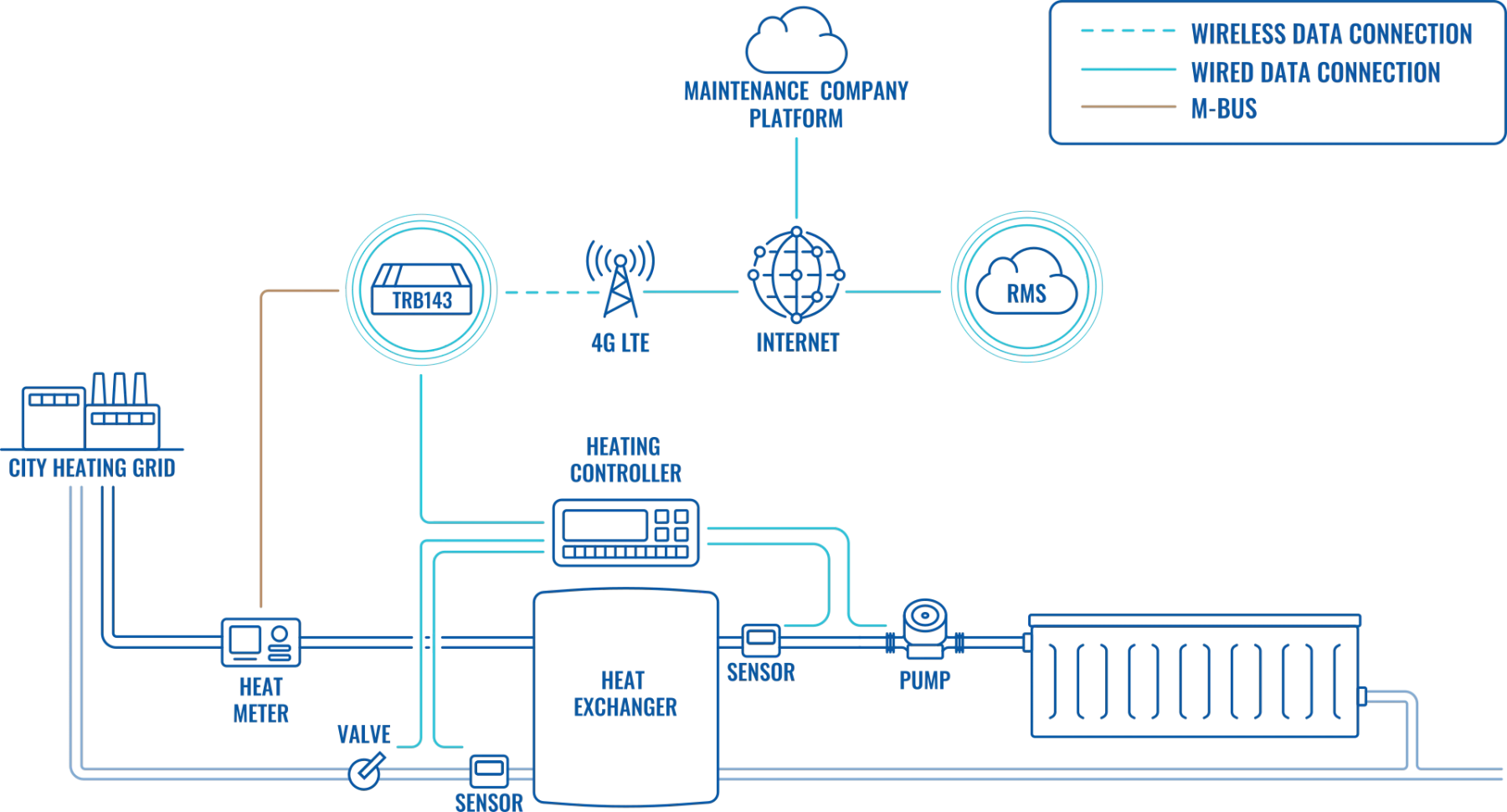
By installing a heat meter on the incoming pipes, the amount of thermal fluid going through the pipes can be monitored digitally and continuously. If the data collected by the meter can then be wirelessly transmitted to a cloud platform, we get telemetry – and efficiency.
Not all networking devices can transmit telemetry data over the Internet, but Teltonika Networks’ TRB143 cellular gateway sure can! This is thanks to its key feature: the M-Bus interface. M-Bus is the European standard for remote reading of utility meters, allowing for wireless transmitting of meter readings.
With a single TRB143 gateway per heating system, the heating usage data of all end clients Is remotely and automatically collected, and the data becomes easily accessible for analysis. This opens the door for enhanced maintenance efficiency of each heating system, as well as enhanced energy efficiency for that blue-green planet we call home. The M-Bus interface can also power up to 6 devices with a wired connection.
This gateway has more to it than this exciting interface – it also has a one-Gigabit Ethernet port and a pair of digital Inputs/Outputs. These make it extra applicable to a myriad of environmental parameter monitoring, analysis, and control scenarios. It also boasts numerous software security features, such as a preconfigured Firewall and Open VPN, and is compatible with FOTA and Teltonika Networks’ own Remote Management System (RMS) for improved remote management.
All of this is packed in a compact, sturdy aluminum housing that can withstand temperatures of -40 °C to 75 °C – perfect for the boiler room environment. You can install it in the solution with either DIN rail or wall mounting, and create a more sustainable future while keeping maintenance efficient and saving costs.