

Highlights
✔ Cellsius is a Swiss student team from ETH Zurich that has created a four-seater electric aircraft with a modular battery system as one of their projects: the e-Sling.
✔ With the aircraft’s design finalised, the team needed a dependable mobile router to transmit real-time data to their ground station for remote monitoring and analysis of the aircraft’s health.
✔ They selected Teltonika’s RUTX50 5G router, which has been instrumental in the project’s success. Offering ultra-fast cellular speeds and low latency, the router ensures seamless real-time data streaming to the ground station.
The challenge – no data must be sacrificed
Introducing new innovations to the world, like electric aircrafts, is both exciting and extraordinary. However, it’s also incredibly time-consuming and challenging, as it involves extensive testing, evaluation, and continuous performance monitoring before it can be deemed safe for use. After all, the sky is unforgiving of any oversight or mistake.
Cellsius, an exceptionally talented student team at ETH Zurich, recently introduced the world to a pioneering four-seater electric aircraft with a modular battery system named e-Sling.
But while Cellsius had the plane’s physical attributes all set up, one crucial element was yet to be completed. The students needed to implement a communication system to provide them with real-time powertrain data readings travelling from the aircraft straight to the ground station for remote monitoring and analysis.
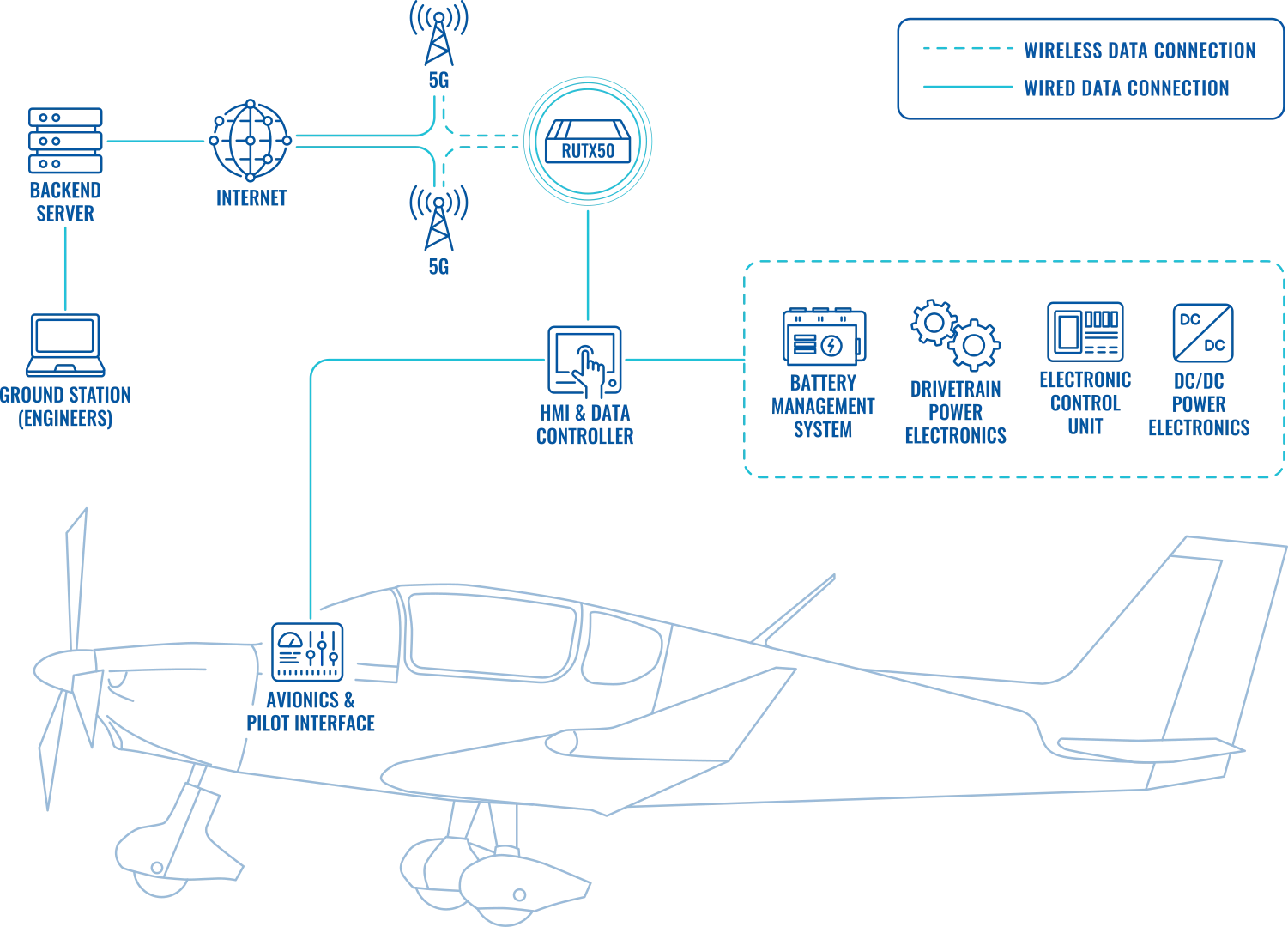
This data that Cellsius must obtain travels from multiple components, such as battery management systems, electronic control units, and drivetrain and DC/DC power electronics. Given the multitude of sources, not just any kind of networking device could ensure robust and uninterrupted transmission while e-Slings turns and whirls in the sky.
Given Cellsius’s need for reliable data transmission and remote monitoring, a mobile router is the ideal choice for efficiently connecting the aircraft to the ground station. However, you can’t plug an arbitrary router and call it a day. No, it has to have a plethora of robust features to meet the connectivity and robustness needs of such an environment.
The mobile router in question must be simple to configure, sturdy enough to withstand physical adversities like vibrations, and adapt to environmental changes, such as temperature, air pressure, and humidity.
It must also balance high efficiency and low power consumption. Ultimately, the electricity powering the aircraft is mainly there to keep it flying, not just to keep its components charged.
So, luckily, Lithuanian winds graciously visited Switzerland and let the Cellsius team know about Teltonika’s RUTX50 5G router, making their challenge our opportunity.
The solution – the winds of 5G connectivity
The RUTX50 5G router enhances Cellsius’s aircraft with abundant features and functions essential for the student team’s e-Sling project, all while looking at us from a bird’s eye view.
Connected to the aircraft’s HMI and data controller via an RJ45 port, the RUTX50 provides this solution with robust network connectivity sourced from mobile signals. This mobile router offers 5G speeds of up to 3.3 Gbps at low latency, essential for real-time data streaming to the ground station. This enables Cellsius to perform remote monitoring and detailed analysis of the aircraft’s status and component health.
Another critical aspect of this 5G wireless router is its backward compatibility with 4G LTE (Cat 20) and 3G. This is particularly relevant when the aircraft flies to areas where 5G signals range from weak to non-existent.
Furthermore, the RUTX50 5G router supports carrier aggregation and failover, which can further enhance the robustness of network connectivity. So, Cellsius doesn’t need to worry about loss of connectivity at all.
When the Cellsius team configured the RUTX50 5G router for their e-Sling project, everything became as clear as sky. Teltonika’s networking devices provide some of the best UX in the world of IoT devices, as the 5G wireless router operates on RutOS – an OpenWRT-based operating system.
This intuitive software offers engineers advanced customisability and efficient workflow, granting Cellsius to quickly set up the 5G router without any hassles or requiring specific know-how of the software.
The physical attributes of this 5G router are equally impressive. In fact, it can withstand some of the harshest environmental challenges. Whether the temperatures are -40 °C or 75 °C, this 5G wireless router remains unphased thanks to its aluminium industrial-grade housing.
The RUTX50 also withstands non-condensing humidity levels ranging from 10% to 90% and can achieve peak efficiency with just 18 W of power.
Not even the sky is the limit for Teltonika’s RUTX50 5G router, as the device feels free like a bird flying over the fields of Switzerland. It effortlessly equips the e-Sling with some of the best and most robust connectivity on the market.