
HIGHLIGHTS
✔ Solexy, a specialist in patented technology for radio, bus, and Ethernet transmission in hazardous classified areas – including refineries, chemical plants, mines, and offshore rigs – needed a certified, self-contained connectivity device for environments where no wireless infrastructure exists or is permitted.
✔ The Teltonika RUT241 was integrated directly into Solexy's explosion-proof SWAR enclosure, certified for Class 1 Division 1 and Zone 1/21 hazardous environments, creating a compact cellular connectivity package.
✔ Approximately 200 units are deployed across customer sites in the USA, providing each sensor cluster with its own independent 4G uplink – with no dependency on customer Wi-Fi networks and with less cybersecurity risks.
THE CONNECTIVITY CHALLENGE IN HAZARDOUS AREAS
Industries operating in hazardous environments – oil and gas refineries, fertilizer plants, chemical processing facilities – face a connectivity problem that most industrial deployments do not. The areas where monitoring matters most are the same areas where standard networking equipment usually cannot operate at all.
Solexy specialises in devices and patented technology for radio and bus transmissions in hazardous classified areas – refineries, chemical plants, mines, offshore rigs, and similar environments. Their product range includes flameproof intrinsically safe barriers, industrial antennas, and Ethernet signal solutions designed to operate safely inside Zone 1, Zone 21, and Class 1 Division 1 classified areas. Where most connectivity hardware stops at the boundary of a hazardous zone, Solexy's technology is built to work inside it.
Two scenarios arise repeatedly in Solexy's customer deployments. In the first, the site is remote or isolated, with no existing wireless infrastructure at all. In the second, existing Wi-Fi infrastructure is present but off-limits: end customers in refineries and chemical plants routinely prohibit third-party devices from connecting to their internal networks, citing cybersecurity policy. In both cases, the result is the same – the sensors have data to transmit and nowhere to transmit it.
What Solexy needed was a cellular connectivity device that could operate safely inside a Zone 1 / Class 1 Division 1 explosive atmosphere, integrate with pre-existing wireless infrastructure where available, and be compact enough to package with their offering as a single, certifiable unit.
HOW THE TELTONIKA RUT241 DELIVERS SECURE IOT CONNECTIVITY
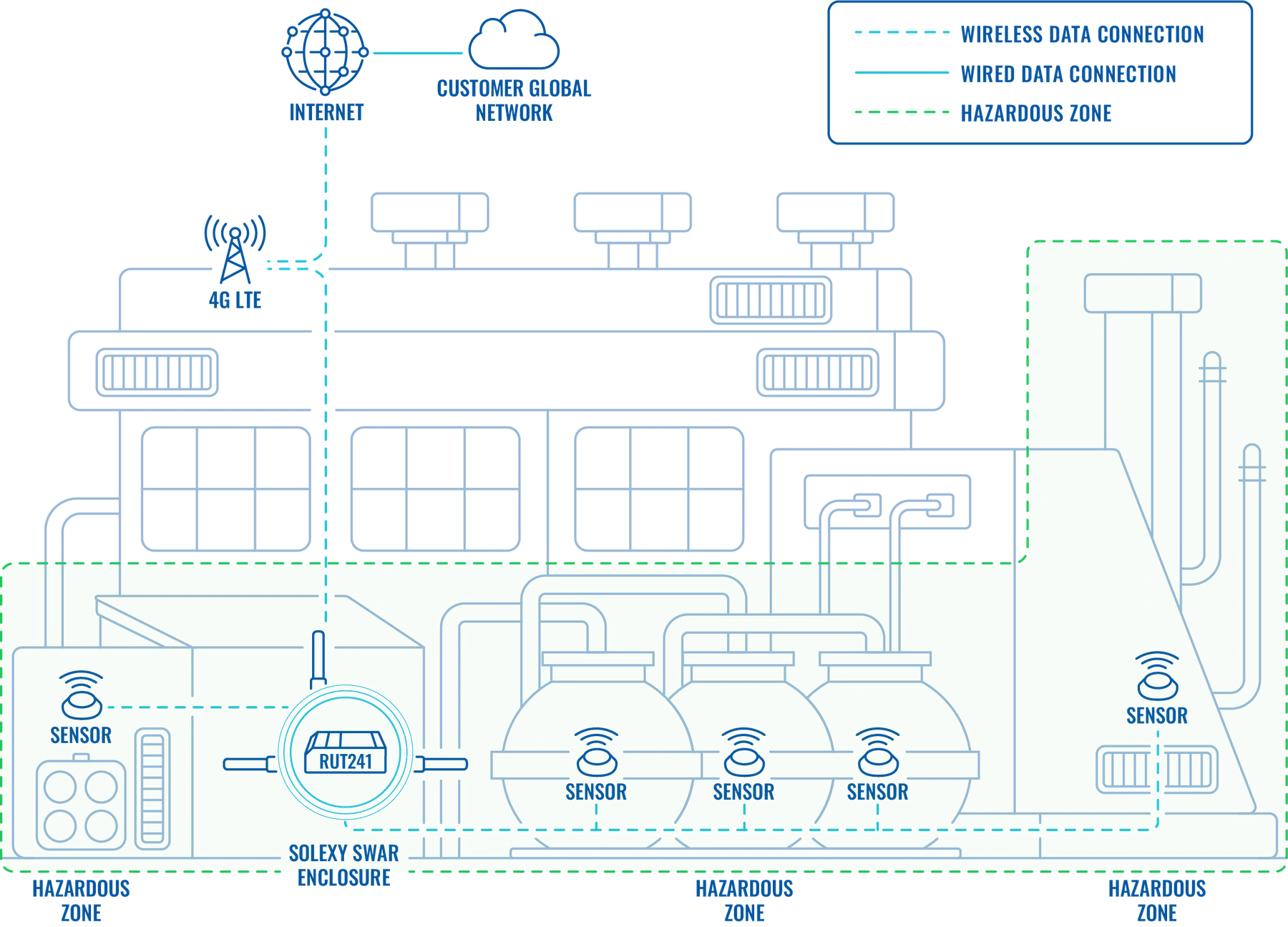
Solexy's answer was to design their own certified enclosure – the Solexy SWAR – and build the connectivity layer directly into it. At the heart of that enclosure is the Teltonika RUT241, a compact 4G router with integrated Wi-Fi and Ethernet, enclosed and protected by Solexy's antenna barriers and explosion-proof housing rated for Class 1 Division 1 and IECEx Zone 1 and Zone 21 classified areas.
The SWAR unit acts as a wireless access point for all Solexy sensors within range. Each sensor connects to the RUT241 over Wi-Fi, aggregating that sensor’s data and transmitting it over 4G to the customer's global network or cloud platform, completely bypassing the need for any on-site infrastructure.
Each SWAR enclosure functions as an independent cellular gateway for a cluster of sensors, with end customers never needing to open their networks, grant access credentials, or modify their infrastructure in any way.
The RUT241 was selected with three capabilities in mind – compact size, combined WiFi and 4G in a single device, and Teltonika's local cellular certifications for the US market – that proved difficult to find together in a router suitable for hazardous area integration. Its form factor kept the SWAR enclosure lightweight and practical for field deployment without specialist installation crews.
Beyond those core requirements, the RUT241 brings enterprise-grade reliability and security to the deployment: it supports VPN tunnelling (OpenVPN, IPsec, WireGuard) to keep sensor data encrypted in transit, offers redundant connection failover to maintain uptime in areas with variable signal, and is built to operate continuously across wide temperature ranges – a practical necessity in the outdoor and industrial environments where Solexy's customers operate.
Its single-device WiFi and cellular capability eliminated the need for separate access point and router hardware inside the enclosure, simplifying both the design and the certification scope – while Teltonika's US cellular certifications ensured the solution was commercially deployable from day one.
Solexy's customers now have continuous, secure visibility into their hazardous-zone environments without relying on wireless infrastructure that many remote or sensitive sites lack, and without exposing customer networks to external devices.
Looking to deploy connectivity in a hazardous or classified environment too? Get in touch with our team and we'll help you find the right Teltonika device for your project.