
SUMMARY
Picture this: you’re driving on the highway and see a bright electric sign telling you to move to a different lane due to road work up ahead. You signal left, move to the next lane, and pass by the workers performing their job some distance later. They seem safe from incoming traffic. Society sure is working as intended.
But wait, who put that warning sign there anyway? Did someone walk into the lane to place it? Wouldn’t they be in serious danger of speeding cars heading their way? That doesn’t sound very safe.
CHALLENGE
Indeed, the safety of road workers in this type of scenario is not something we often think about, but behind the scenes, a lot of problem-solving is needed to ensure it.
To really maximize the safety of road workers, keeping them as far as possible from incoming traffic is priority number one. Any amount of interaction with the electric sign that can be done remotely should be done remotely.
This poses a technical challenge. Remote access requires connectivity, but its cellular signal grows weaker the further apart the devices connected to it are. In other words, the further the workers are from the sign, the safer they are, but the harder it becomes for them to access the sign effectively.
Safety isn’t something you want to compromise on. Technology should make things simpler and safer for us, after all. Can effective connectivity be established and maintained while still keeping the workers at a safe distance?
PARTNERS
MCS is a Dutch provider of IoT solutions, services, and products and is one of our distributors. Using its connectivity expertise, it makes complex technologies simple and improves people’s lives and work.
EBO van Weel is a Dutch traffic and safety innovator, developing intelligent applications for safe and optimal traffic flow and systems for ensuring safe road work areas. In addition, it’s also a supplier of customizable truck body solutions.
SOLUTION
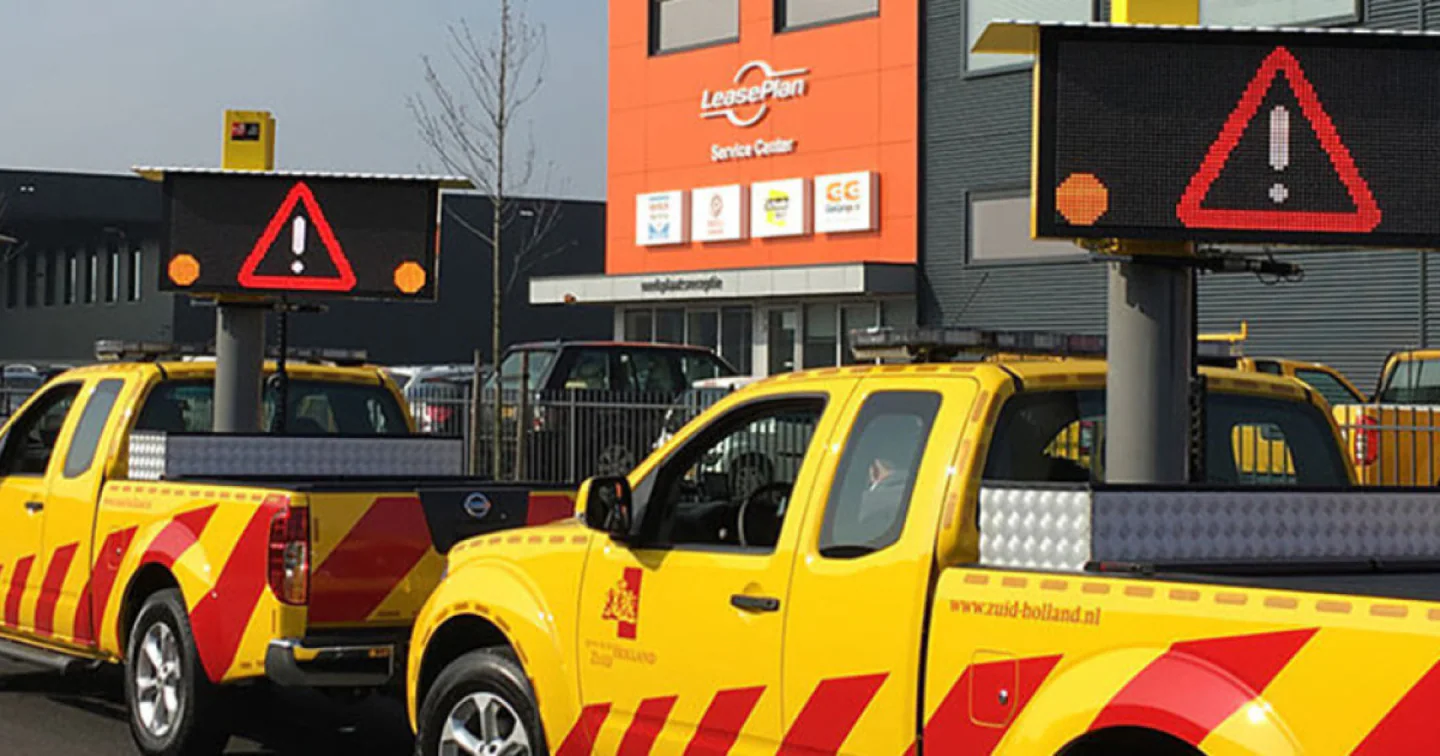
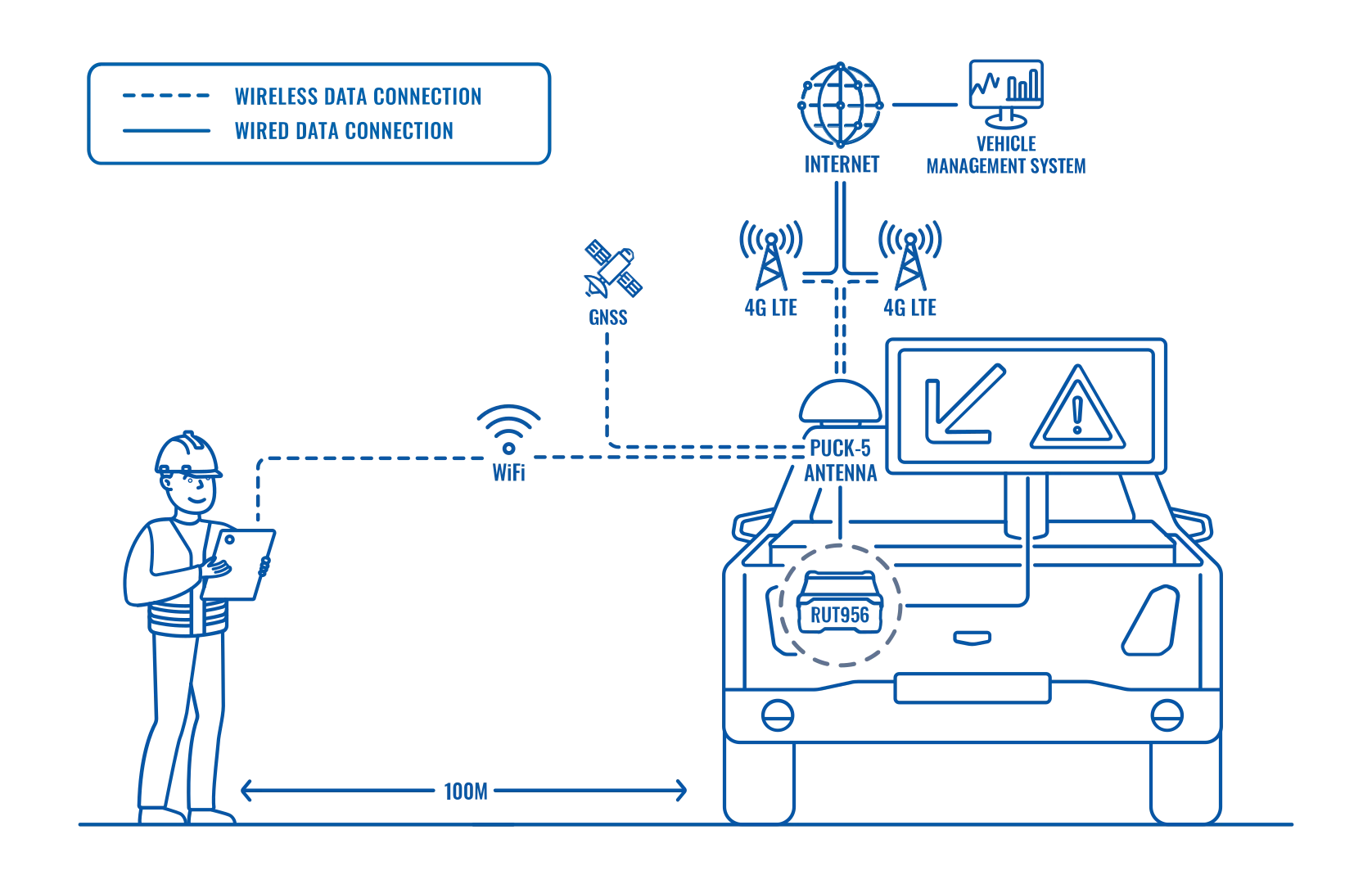
When approached by the Dutch Ministry of Infrastructure and Water Management to tackle this problem, EBO came up with an innovative setup. Its basic premise is a full-color display mounted on the back of a road work vehicle visible from half a kilometer away (about one-third of a mile).
The display alerts incoming traffic about work being done in a particular part of the road and can start doing so way before it arrives at the worksite, thereby diverting vehicles away on its way there. Workers then carry a mobile device connected to the vehicle management system Autodrip 2.0., with which they can access the sign remotely.
Via MCS, EBO chose our RUT956 industrial cellular router and our partner’s antenna, Poynting’s PUCK-5, for optimal connectivity. Combining the uninterrupted connection of the RUT956 with the enhancing signal of the PUCK-5, the workers can manage the sign remotely without needing to come near it, and near the dangers of the open road.
BENEFITS
Equipped with dual SIM and failover functionality, RUT956’s internet connection is stable, reliable, and tailor-made for industrial work.
Multiple connectivity options, including RS232 and RS485 interfaces; antenna compatibility, and GNSS functionality make RUT956 a flexible connectivity device for a variety of different applications.
A rugged casing, vibration resistance, and the ability to withstand extreme temperatures between -40°C and 75°C make it a reliable role player in pretty much every spot on the planet we would reasonably build a road in.
WHY TELTONIKA NETWORKS?
According to EBO, you can’t be too critical about connectivity. “Everything stands or falls with the connection. If we have no connection, the system isn’t online.”
We gladly accept our clients’ high standards, both because we see them as justified and because we apply them ourselves when designing our products. We’re not in the business of everything falling with the connection. We’re in the business of everything standing with it.